
本笔记用于HAREC级别的业余无线电执照测试,适用于CEPT成员国(欧盟、欧洲经济区、英国、瑞士等国)以及CEPT互惠许可国(美国、加拿大、澳大利亚等)。相关法律法规和操作请勿使用在中国无线电协会辖区。
Technical Basics
Ohm’s Law
Derived forms:
Voltage (V)
电压 = potential difference
单位:volt (V)230V mains is dangerous
Current (I)
电流 = flow of charge
单位:ampere (A)大电流需要粗导线
Thin wire + high current -> overheating riskResistance (R)
电阻 = opposition to current
单位:ohm (Ω)
Electrical Power
Derived forms:
Series and Parallel
Series resistors
Parallel resistors
DC and AC
DC = Direct Current 直流
AC = Alternating Current 交流
- RMS = Root Mean Square 有效值(均方根值)
Frequency & Wavelength
RF: MHz, Wavelength: metre
Analogue vs Digital
Analogue
Continuous waveform.Digital
Discrete levels (0 and 1).
Better noise resistance
Software processing possible
Transmitters
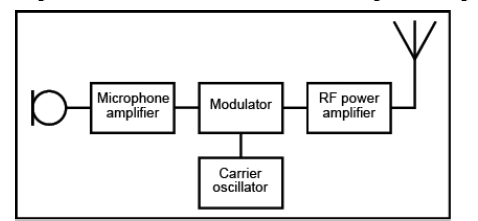
Microphone Amplifier
Limits audio frequency range (typically 300Hz–3kHz). Prevents unnecessary bandwidth use.
减少带宽占用,避免邻道干扰
Carrier Oscillator 载波振荡器
The carrier oscillator produces the RF signal, the carrier frequency, to transmit the information.
载波振荡器产生射频信号(即载波频率)以传输信息。
Modulator 调制器
The process of getting the radio signal to carry an audio signal is called “Modulation“.
无线电信号用于传输音频信号的过程被称为“调制”。
AM: Amplitude Modulation
- Carrier amplitude varies with audio signal.
- Frequency remains constant.
- Overmodulation causes distortion
- Causes adjacent channel interference
FM: Frequency Modulation
- Carrier frequency varies with audio signal.
- Amplitude remains constant.
- Excessive deviation → interference
- Microphone gain too high → overmodulation
CW, stand for carrier wave. The carrier is simply turned on and off using a Morse
Key and with a little electronic smoothing it becomes more pleasant
to listen to.
Sidebands
Modulating the carrier has another effect on the transmitted signal; it introduces “sidebands”.
对载波进行调制会产生另一种作用: “边带”- Upper Sideband (USB)
- Lower Sideband (LSB)
SSB(Single Sideband):
- Removes carrier
- Removes one sideband
- More efficient
SSB优点:
- All power concentrated in one sideband
- Greater efficiency
Data Modulation
Different tones represent binary data (0 and 1).
Examples: PSK31, FT8.RF Power Amplifier
Increase RF signal to transmission power level.- 必须连接 Proper Antenna 或 Dummy Load
Receivers
A receiver must:
- Select the wanted signal
- Reject unwanted signals
- Amplify weak signals
- Demodulate the information
过滤, 放大, 解调
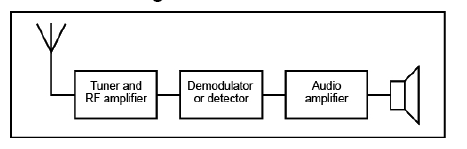
Antenna
Convert radio waves into weak voltage signals
电磁波->微弱电压
Tuner and RF amplifier
Tuning 调谐
共振电路的核心关系:
L = Inductor电感
C = Capacitor电容
改变 C 或 L → 改变共振频率。
Amplification 放大
The wanted signal is too weak to use directly, so the RF amplifier amplifies it (transistor circuit).
Demodulator 解调器
After tuning and RF amplification, the output is a single modulated signal strong enough to be demodulated. For AM this has historically been called “detection”.
The detector must suit the transmitter’s modulation method: AM, FM, SSB (USB/LSB).
SDR
In a Software Defined Radio (SDR), the received signal is sampled and digitised as early as possible in the receiver.
在软件无线电中,接收到的信号会尽可能早地被采样并数字化。
- Sampled: 在固定时间间隔对信号电压进行测量
- Digitised: 把这些测得的电压转换成计算机可以处理的数字
Wideband Sampling and Display
The entire sampled frequency band can be displayed on a screen as a panoramic display (usually waterfall).
整个被采样的频率范围可以在屏幕上以“全景频谱显示”(通常瀑布图)的形式呈现。
Instead of tuning one narrow frequency first, SDR can digitise a wide block of spectrum and show multiple signals at once.
SDR不是先只调一个窄频点,而是可以把一整块频谱数字化,并同时显示多个信号。
Digital Filtering and Demodulation
“Digitally filtered” means unwanted frequencies are removed mathematically rather than by analogue tuned circuits.
Digital to Analogue Conversion
After digital processing, the signal is converted back to analogue form to drive headphones or a loudspeaker.
Advantages of SDR
Much of the receiver’s functionality is implemented in software, making it flexible and upgradable.
接收机的大部分功能由软件实现,因此更加灵活且可升级。
Different modes (AM, FM, SSB, data) can be supported without changing hardware.
无需更换硬件即可支持不同模式
Feeders & Antennas
Feeders 馈线
Feeder
A feeder carries RF energy between the transmitter/receiver and the antenna.
馈线用于在发射机/接收机与天线之间传输射频能量。
RF power must reach the antenna efficiently.
射频功率必须高效送达天线。
Coaxial Cable (COAX) 同轴电缆
To prevent radiation from the feeder, it is usually made as coaxial cable.
为了防止馈线自身辐射,通常使用同轴电缆。
Structure:
- Inner conductor 内导体
- Dielectric 绝缘介质
- Outer conductor (braid/screen) 外导体(屏蔽层)
- Outer sheath 外护套
The outer conductor provides screening.
外导体提供屏蔽作用。
Prevents radiation loss and external interference.
防止射频泄漏并抵抗外界干扰。
Twin-feeder (Balanced feeder)
Another feeder sometimes used on HF is twin-feeder (two unscreened parallel wires).
HF 有时使用另一种馈线:双线馈线(两根未屏蔽导线平行)。It is balanced: equal and opposite signals on the two conductors.
两根导体上的信号大小相等、方向相反。Why it doesn’t radiate overall: radiation from one conductor is cancelled by the other.
为什么整体不辐射:一根线的辐射会被另一根线“抵消”。But it must be kept away from other conductors to avoid upsetting the balance.
但它必须远离其他导体,否则会破坏平衡。
Feeder Loss (dB)
All feeders exhibit loss because some RF energy is converted to heat by feeder resistance.
所有馈线都有损耗:部分射频能量因馈线电阻转化为热。
Loss applies on transmit and receive.
损耗在发射与接收时都存在。
Longer feeder → greater loss.
馈线越长 → 损耗越大。
Loss increases with frequency, so choose low-loss feeder for VHF/UHF.
损耗随频率升高而增大,因此 VHF/UHF 要选低损耗馈线。
Manufacturers quote loss in decibels (dB).
厂家常用 dB 标注损耗。
- Example: 10 m has 1 dB loss → 20 m has 2 dB loss
例:10米损耗1 dB → 20米损耗2 dB - 3 dB loss is half the power
3 dB 损耗 = 功率减半
Characteristic Impedance 特性阻抗
Coaxial cable has a characteristic impedance.
Amateur radio standard: 50 Ω
特性阻抗 = 高频传播时电压与电流之比。
Impedance Matching 阻抗匹配
Maximum power transfer occurs when:
当天线阻抗 = 馈线阻抗(通常 50Ω)时,功率传输最大。
Standing Wave Ratio (SWR) 驻波比
If impedances do not match, some power is reflected.
阻抗不匹配时,部分功率会反射。
Forward wave + reflected wave → standing wave
前进波 + 反射波 → 驻波
SWR measures mismatch.
- SWR = 1:1 → perfect match
- High SWR → poor match
High SWR may damage transmitter.
高驻波比可能损坏发射机。
Antennas
Antenna
An antenna converts electrical RF energy into electromagnetic waves.
天线将射频电能转换为电磁波。
On receive, the reverse occurs.
接收时过程相反。
Dipole Antenna (Half-wave) 半波天线
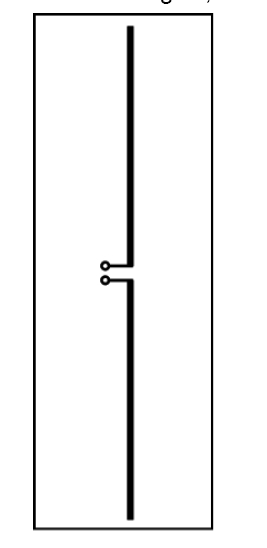
The dipole is the basic antenna and is half a wavelength long.
偶极天线是基础天线,总长度约为半波长。
Half-wave dipole length:
f in MHz, L in metres
If mounted vertically, it radiates equally in all horizontal directions.
垂直架设时,水平方向上各方向辐射大致相同。
If mounted horizontally (common at HF), it radiates well from the sides but not off the ends; ideally it should be side-on to the desired direction of maximum signal.
水平架设(HF常见)时,侧向辐射好、端向辐射弱;理想情况下应让天线“侧面对着”目标方向以获得最大信号。
The 1/4-wave Ground Plane (λ/4) 四分之一波地平面天线
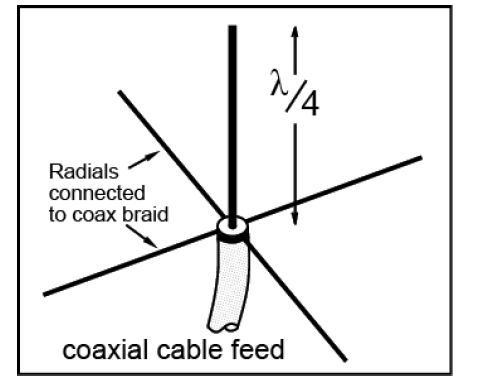
Named because the radiating element is ¼ wavelength (λ/4) and is always vertical.
称为四分之一波长地平面天线,因为有源辐射体长度为 λ/4,且始终垂直。
It uses 4 horizontal radials forming a “ground plane” (an earthed surface acting like a mirror to radio waves).
它有4根水平**径向线(radials)**形成“地平面”(接地表面,像镜子一样对无线电波起作用)。
It is omni-directional in the horizontal plane and does not radiate straight upwards.
它在水平方向全向辐射,并不会把能量直直向上打到天空。
The Yagi (Directional) 八木天线
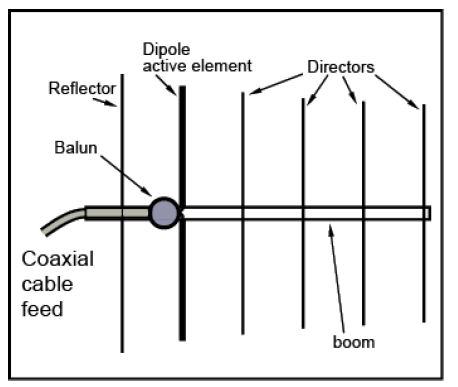
The Yagi is directional on both transmit and receive; it focuses energy like a searchlight.
八木天线在发射与接收时都是定向的;它像探照灯一样把能量聚焦到某个方向。
Maximum signal is towards the tapering end.
最大信号指向“逐渐变细的一端”(前向)。
The thicker vertical line in the figure is actually a dipole (half wavelength) as the driven element connected to the feeder; a balun is needed if coax is used.
图中较粗的那根其实是半波长偶极子,作为**有源振子(driven element)**接馈线;若使用同轴馈线,需要**巴伦(balun)**。
The focusing effect gives gain: signal in the wanted direction increases while other directions reduce; this can give greater range or allow lower transmit power.
定向聚焦带来增益:目标方向信号增强,其他方向减弱;可增加通信距离或降低发射功率。
The 5/8-wave Ground Plane 八分之五波地平面天线
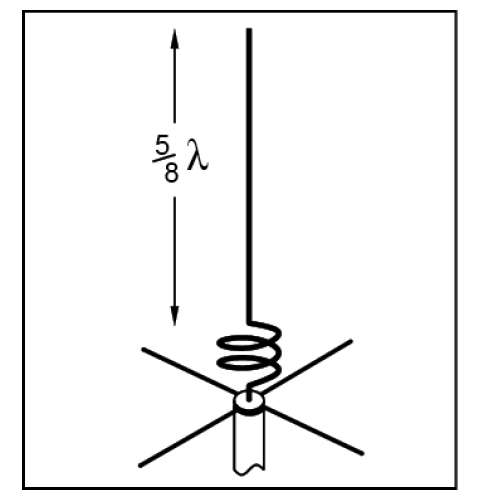
A development of the ¼-wave ground plane; it directs signals better towards the horizon rather than up in the air.
它是¼波地平面天线的发展型,更擅长把信号“压向地平线”,而不是往天上打。
It is always vertical and omnidirectional.
它始终垂直安装,且为全向。
The active element is 5/8 wavelength long; due to size, it is most often used on VHF/UHF.
有源振子长度为 5/8 波长;因尺寸原因,多用于 VHF/UHF(波长更短)。
The coil at the base is part of matching the antenna to the coax.
底部线圈是天线与同轴电缆匹配的一部分。
The End-fed (Long Wire) 端馈天线
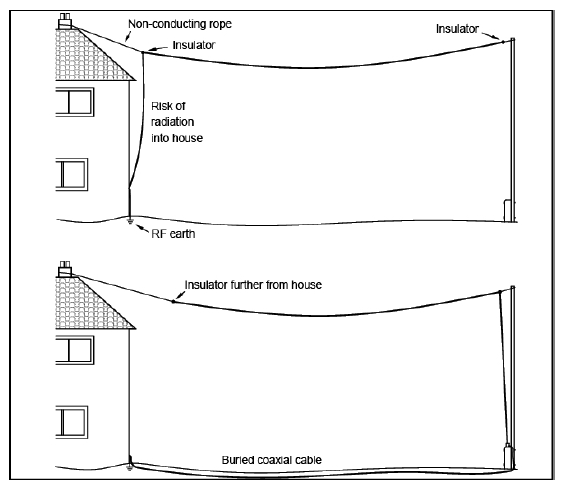
An end-fed long wire is popular for receiving HF where the wavelength may be longer than the garden; it is often a random length and may present a matching problem on transmit.
端馈长线天线常用于接收HF(波长可能比院子长);它往往是“随意长度”,用于发射时可能出现匹配问题。
Feeding it near the house can cause EMC problems (high voltages/currents near the house; strong radiation may upset TV/electronics). Better to feed it at the far end using a buried feeder.
在房屋附近馈电可能引发EMC问题(近房处可能有高电压/大电流,强辐射容易干扰电视/电子设备);更好的做法是在远端馈电,并用埋地馈线。
Radiation Pattern (Polar Diagram) 辐射图
Dipole pattern: maximum radiation at right angles to the dipole, minimum off the ends.
偶极方向图:最大辐射在天线侧向(与天线成直角),端向最小。

Yagi pattern: strong main lobe forward, weaker side lobes, minimum to the rear.
八木方向图:前向主瓣最强,旁瓣较弱,后向最小。

ERP / EIRP 有效辐射功率/等效辐射功率
Effective Radiated Power recognises antenna gain:
erp = power fed to antenna × antenna gain
有效辐射功率考虑天线增益:
erp = 送入天线的功率 × 天线增益
ERP uses dipole reference; EIRP uses isotropic reference (and dBi = dBd + 2.15).
ERP 以偶极为参考;EIRP 以各向同性为参考(且 dBi = dBd + 2.15)。
For Foundation purposes: 10 W EIRP is the same as 6.1 W ERP.
Foundation 记忆点:10W EIRP = 6.1W ERP。
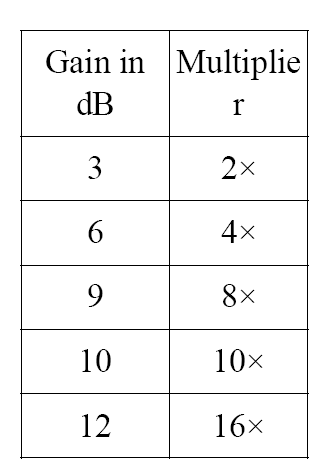
其中:
= 输入功率 = 输出功率
电压倍数是20不是10, 所以双倍电压是+6 dB, 双倍功率是+3 dB
Polarisation 极化
Polarisation means which way up the antenna is; it determines wave polarisation.
极化就是天线“竖着还是横着”;它决定辐射波的极化。
For these antennas, wave polarisation is the same as the driven element.
对本章这些天线而言:无线电波极化与有源振子方向一致。
VHF/UHF convention: FM uses vertical, SSB uses horizontal; whichever you use, both ends should match.
VHF/UHF 习惯:FM 用垂直极化,SSB 用水平极化;不管采用哪种,两端天线极化必须一致。
On HF, polarisation is less critical because it can change in the ionosphere.
HF 上极化不那么关键,因为电离层会改变极化。
Transmitting and receiving antennas should have the same polarisation.
发射与接收极化必须一致,否则信号衰减严重。
Antenna Gain 天线增益
Gain describes how well an antenna concentrates energy in a particular direction.
增益表示天线将能量集中到某一方向的能力。
Measured in dB.
Gain does not create extra power.
增益不产生额外功率,只是重新分布。
Feeding and Matching Antennas 馈线-天线匹配
The connection to an antenna is its feed-point.
与天线连接的点称为馈电点(feed-point)。
If a 50Ω resistor is connected to a 50Ω feeder, all power is absorbed (heat); if not 50Ω, some signal is reflected back.
若在50Ω馈线上接50Ω电阻,功率全部被吸收变热;若不是50Ω,会有信号反射回馈线。
An antenna “looks like a resistor” to the feeder; if it does not look like 50Ω, reflection occurs.
对馈线而言,天线“看起来像一个电阻”;如果它不是50Ω,就会产生反射。
Correct matching: getting the feed-point impedance right. Correct size (e.g., dipole half-wave) gives good match and maximum radiation; wrong frequency → wrong size → poor match → reflection.
正确匹配:让馈电点阻抗合适。天线尺寸正确(如偶极半波长)匹配好、辐射最大;频率用错导致尺寸不对则匹配差、出现反射。
Standing Waves and SWR Meters 驻波和驻波表
Reflected power combines with forward power on the feeder, creating standing waves; SWR is the ratio of peaks to troughs.
反射功率与前向功率在馈线上叠加,形成驻波;驻波比是峰值与谷值之比。
An SWR meter measures the two signals and indicates SWR.
驻波表测量前向/反射信号并显示SWR。
If SWR unexpectedly increases, most likely cause is antenna damage; investigate before transmitting.
SWR 突然升高,最可能原因是天线损坏;继续发射前应排查。
Target: aim for SWR 1.5:1 or better; over 2:1 risks damage.
目标:SWR 尽量 1.5:1 或更好;超过 2:1 有损坏风险。
Antenna Matching Unit (AMU / ATU) 天线匹配器
Common at HF when one antenna is used on several bands; it allows the transmitter to “see” a good match and operate normally.
HF 常见(一个天线多频段使用);AMU 让发射机“看到”一个良好匹配,从而正常工作。
It does not actually tune the antenna; only cutting the antenna to correct length tunes it.
它并不真正“调谐天线”;天线只有裁剪到正确长度才算调谐。The Foundation Licence Manual f…
AMU cannot make a wrong-length antenna radiate as well as a correct one.
AMU 不能让长度错误的天线辐射效果达到正确长度天线的水平。The Foundation Licence Manual f…
Baluns 巴伦
A dipole is a balanced antenna; it requires two equal and opposite signals.
偶极是平衡天线,需要两路大小相等、方向相反的信号。
Coax is unbalanced (live centre + earthed screen) and is not suitable to directly feed a dipole.
同轴是不平衡的(中心“热端”+ 接地屏蔽),不适合直接馈电偶极。
A balun converts the coax signal into two signals suitable for feeding the dipole.
巴伦把同轴的单端信号转换成适合偶极的两路平衡信号。
If coax is connected directly, RF current can flow on the outside of the braid and radiate (including inside the house), causing interference; must be avoided.
若直接把同轴接到偶极,射频电流会沿屏蔽层外侧回流并辐射(甚至在屋内辐射),可能造成干扰,必须避免。
(Extra info in book) Some baluns can also transform impedance (e.g., 4:1 balun for 200Ω to 50Ω).
(书中补充)部分巴伦还能变换阻抗(如 4:1 把 200Ω 匹配到 50Ω)。The Foundation Licence Manual f…
Dummy Loads 假负载
A dummy load is a carefully constructed resistor that absorbs all transmitter power, presents a good match, and must be well screened to minimise radiation.
假负载是精心制作的电阻,可吸收发射机全部功率并呈现良好匹配,同时必须良好屏蔽以减少辐射。
It allows setup/testing without radiating significant power.
它允许在几乎不辐射的情况下进行设备设置与测试。
Propagation 传播
Electromagnetic Waves 电磁波
Radio signals travel as electromagnetic EM waves, which consist of oscillating electric and magnetic fields, support each other and allow the signal to move through space without requiring a physical medium.
无线电信号以电磁波的形式传播。电磁波由交替变化的电场与磁场组成,它们相互维持,使信号能够在空间中无需任何物质介质传播。
Line-of-Sight (LOS) 视距传播
At VHF and UHF, most communication is by line-of-sight. This means the transmitting and receiving antennas must be able to “see” each other over the curvature of the Earth.
Ground Wave 地波
At lower frequencies (LF, MF), radio waves can follow the curvature of the Earth. These are called ground waves.
Ground wave range depends on:
Ground conductivity 地表导电性
Frequency 频率
Power 发射功率
Better over sea water, worse over dry soil.
海水导电性最好、传播最远;干燥土地最差。
Ionospheric Propagation (Skywave) 电离层传播(天波)
At HF (3–30 MHz), radio waves can be refracted by ionised layers high in the atmosphere, allowing them to return to Earth beyond the horizon.
Allows long-distance (DX) communication
Ionosphere Structure 电离层结构
- D layer (absorbing) 吸收
- 白天吸收<10MHZ的低端HF
- 夜间消失,使得HF通信质量显著改善
- E layer (weak refraction) 弱折射
- 有限折射,支持中等距离的HF
- Sporadic-E (偶发E层
, strong seasonal refraction) 强折射、季节性 - 主要出现在夏季,折射非常强,甚至能把VHF传播到几百上千公里
- F layer (main HF refraction; splits into F1 and F2)
- 远距离HF传播,白天分裂成F1和F2层,夜间合并
- 高度最高,远程通信中最重要
Maximum Usable Frequency (MUF) 最大可用频率
MUF is the highest frequency that will be refracted back to Earth for a particular path.
MUF 是某条路径下能够被电离层折返回地面的最高频率。
Signals above the MUF pass through the ionosphere into space instead of returning.
高于 MUF 的信号会穿透电离层进入太空,不会返回地面。
Lowest Usable Frequency (LUF) 最低可用频率
LUF is the lowest frequency that will reach the ionosphere without being absorbed (mainly by the D layer).
LUF 是能够到达电离层而不被 D 层吸收损失的最低频率。
Between LUF and MUF is the usable HF band for the path.
Skip Distance & Skip Zone 跳距和跳区
The skip distance is the minimum distance from the transmitter to the point where the skywave returns to Earth.
跳距是天波第一次返回地面时,与发射机之间的最短距离。
The skip zone is the region between the end of ground wave coverage and the first skywave return, where no signal is received.
跳区是地波覆盖结束点与天波第一次落地点之间的区域,在该区域无法接收到信号。
VHF/UHF Propagation VHF/UHF 传播
由于波长短,VHF/UHF 主要以视距传播。但是仍有特殊传播机制:
Diffraction 绕射
VHF/UHF 可以略微绕过障碍,但程度远小于 HF
Tropospheric Scatter
Some VHF/UHF signals are scattered by irregularities in the troposphere, enabling communication beyond line-of-sight (hundreds of km).
Temperature Inversions (Ducting) 波导效应
During certain weather conditions, warm air above cooler air forms layers that trap VHF/UHF signals, guiding them over very long distances.
当暖空气叠在冷空气之上时,会形成“温度逆温”,在空气层中产生自然波导,使 VHF/UHF 信号沿层传播,距离可达数千公里。
Absorption, Noise, Interference 吸收、噪声、干扰
Noise increases at lower frequencies (atmospheric, man-made).
低频噪声更大(雷电、大气噪声、人造噪声)。
VHF/UHF 噪声低,但更容易被地形/建筑物阻挡。
Interference & EMC 干扰与电磁兼容
What is Interference 干扰是什么
Interference occurs when unwanted radio signals affect the operation of other electronic equipment.
干扰是指不需要的射频信号影响其他电子设备的正常工作。
This may affect:
- Radios 收音机
- Television 电视
- Computers 计算机
- Alarm systems 报警系统
Interference can be caused by:
- Harmonics 谐波
- Overloading 过载
- Poor screening 屏蔽不良
- Faulty equipment 故障设备
Harmonics 谐波
When a transmitter generates a signal at frequency
当发射机工作在频率
These are called harmonics.
这些称为谐波。
Example:
Transmit at 145 MHz
Second harmonic = 290 MHz
Third harmonic = 435 MHz
Harmonics may fall into other services’ bands and cause interference.
谐波可能落入其他业务频段并造成干扰。
Transmitters must include low-pass filters to suppress harmonics.
发射机必须使用低通滤波器抑制谐波。
Overloading 过载
Strong RF signals can overload nearby equipment.
强射频信号可能使附近设备过载。
This does not mean the transmitter is faulty.
这并不一定表示发射机故障。
Overloading happens when:
- The signal is too strong
- The receiving device has poor filtering
信号过强或设备滤波能力差都会导致过载。
EMC (Electromagnetic Compatibility) 电磁兼容
EMC means equipment must operate correctly in its electromagnetic environment without causing unacceptable interference.
EMC 意味着设备必须在其电磁环境中正常工作,同时不对其他设备造成不可接受的干扰。
Good EMC practice includes:
- Proper grounding 正确接地
- Good screening 良好屏蔽
- Use of filters 使用滤波器
- Ferrite chokes 使用铁氧体磁环
Ferrite Chokes 铁氧体磁环
Ferrite chokes reduce unwanted RF currents flowing on cables.
铁氧体磁环用于减少电缆上的不必要射频电流。
They are commonly fitted to:
- Power cables 电源线
- Coax feeders 同轴馈线
- Audio cables 音频线
They help prevent RF from entering household electronics.
它们可以防止射频进入家用电子设备。
Reducing Interference 减少干扰
Steps to take if interference occurs:
- Check your equipment is functioning correctly
确认设备正常工作 - Check antenna and feeder connections
检查天线与馈线连接 - Use low-pass filters
使用低通滤波器 - Add ferrite chokes
加装磁环 - Reduce transmit power if necessary
必要时降低发射功率 - Cooperate politely with neighbours
与邻居友好沟通
Safety 安全
Mains Electricity 市电安全
Mains voltage (230V) is dangerous and potentially fatal.
230V 市电可能致命。
Never work on equipment connected to mains power.
切勿在接通市电时维修设备。
Always disconnect before opening equipment.
打开设备前必须断电。
High Voltage in Transmitters 发射机高压
Some transmitters contain high voltages internally.
某些发射机内部含有高电压。
Capacitors can remain charged even after power is removed.
电容在断电后仍可能带电。
Always discharge safely.
必须安全放电。
RF Burns 射频灼伤
RF burns can occur when touching an antenna while transmitting.
发射时触碰天线可能造成射频灼伤。
Unlike electric shock, RF burns may not cause muscle contraction but can cause deep tissue heating.
与电击不同,射频灼伤主要是深层组织加热。
RF Exposure 射频暴露
RF energy can heat body tissue.
射频能量会加热人体组织。
Exposure limits exist to protect health.
存在射频暴露限值以保护健康。
Do not stand close to high-gain antennas while transmitting.
发射时不要靠近高增益天线。
Lightning Protection 防雷
Antennas should be protected against lightning.
天线必须采取防雷措施。
Use:
- Lightning arrestors 避雷器
- Proper earthing 良好接地
Disconnect antenna during storms.
雷暴时断开天线。
Safe Antenna Installation 天线安装安全
Antennas must not:
- Fall onto power lines
- Endanger public safety
天线不得:
- 倒向电力线
- 危及公众安全
Always ensure secure mounting.
必须确保牢固安装。